Cow Call Draws Elk Like Crazy
Mark Henckel’s newspaper account follows Don Laubach, the Cow Talk call, and the early business in Gardiner, Montana. It names Laubach and Eastman in the formation of E.L.K., Inc.
Read the Record → MT E.L.K., INC.THE LANGUAGE OF THE WILD
Idaho Outdoor Digest / November 1987
A regional outdoor feature explains the advantage of imitating cow and calf sounds and describes Laubach’s call and instructional video.
Listen to full text · English
Reads the full source text. Historical claims, prices and contacts are reproduced as source material, with company-name styling standardized. Unclear words are marked. Resume may repeat the current passage. This complete article contains a short unreadable passage marked in brackets.
Audio uses your device’s available voices. JavaScript is required.
To Take A Bull, Talk Like A Cow. By Scott Morrison. Idaho Outdoor Digest, November 1987, pages B8 and B10. Each season, that old saying rings true for the sportsman who returns home from elk hunting empty-handed. And while the elk hunter is beginning to see the necessity for some new invention, to say that the elk themselves haven’t invented new ways to slip away isn’t necessarily so. What elk have done is learn to an ever-advancing tide of development, an increase in hunting pressure, and a decrease in grazing availability.
With this in mind, the hunter who thought elk were smart 50 years ago should realize that they have PhDs in hunter avoidance now. Crafty, quick and elusive, the phantom of the woods is gaining more respect these days — and the old hunting grounds aren’t producing as they once did for the hunters who come home with vague expressions and sighs about the scarcity of game.
Hunters have reconciled themselves to the idea that the big herds of yesterday and the massive racks like those that sit amongst the cobwebs and soot of old hunting lodges have all but left the country; but this excuse is unfounded. The big bulls are there, yet a bit further back in the hills, maybe slightly better hidden, and maybe just a little less vocal. In answer to the need, first came the bugle. That distinctive challenging call was probably the result of a missed shot and a remaining spent cartridge.
As an unscathed elk topped the far ridge, the young inventor may have picked up his empty cartridge and whistled a curse to the old bull in his own language...and the bull wheeled at the sound, returning to killing range. That may have been the scenario but who knows? At any rate, bugles began flooding the outdoor marketplace and hungry hunters ate them up as a sure edge. The bugle did work and continues to work today, although somewhat confined to a specific circumstance.
A hunter's chance at calling in a bull with a bugle challenge is limited to a short period of time when bull elk are pumped to the gills with hormones in preparation for the rut. The bugle cannot be underestimated, though, in its ability to help locate elk for the hunter who has mastered the call. Unfortunately, the bugling season will have ended by the opening day of the rifle season for most hunters in many areas.
Even so, to the hunter's disadvantage, more and more sportsmen have picked up a spare bugle or two in hopes of luring a bull from its hiding place but elk have begun to recognize the imitation. Truly, the effectiveness of the bugle has dwindled in recent years as a steady increase in hunters float their poorly-tuned melodies across the hills. Sometimes, the only harmony is with another hunter. A growing number of hunters are finding themselves lulling one another as the elk retreat to their soundproof thickets.
Many hunters may not be aware that elk, a herd animal by nature, have a means of communicating which once imitated can be an incredible advantage to those who know about it. Even more, these sounds are made year round and are therefore not limited to a short period of time which can be difficult to predict. One notable sound other than the bugle is a “bark” emitted by both cows and bulls. Generally the bark is a means of communicating danger or distress amongst members of the herd or kin.
The hunter remembers this sound all too well as a last note before the crashing timber and the melting of white rumps into the woods. The most common sound in the elk herd is a high-pitched “ee-ow”, uttered by cows, bulls and calves alike. The cow’s has a slightly longer duration. This particular call is mainly used by elk as a means of communicating location. Elk on the move through timber often “talk” in much the same way a group of kittens “me-ows” after the [unclear words] as they stroll down a sidewalk. For the hunting public, though, these sounds were a part of a void yet to be filled in the retail call market.
It was about six years ago that the Gardiner, Montana hunter, Don Laubach, realized the need for such a call to improve his own hunting success. Laubach began experimenting with a number of homemade devices and finally hit upon a design that was not only compact and easy to use, but the call could be adjusted to imitate both cow and calf sounds. At about the same time, Gordon Eastman, an outdoor video maker and friend of Laubach's, decided to get together to do a video on calling elk.
In the end, the success of the call and sales of the video itself prompted Laubach to begin manufacturing the call at his hometown Gardiner location. What better place for an elk call to come from than the heart of elk country at the edge of Yellowstone National Park? Laubach dubbed the new invention “Cow Talk.” It is nothing more than a piece of molded, hinged and slotted plastic with a rubber band. It is nothing less than a simple design with the capability of making a variety of sounds that can imitate the original so well the elk find it difficult to differentiate. That was 2½ years ago.
Today, "Cow Talk" is retailed in more than 7,000 stores across the West. "My file drawer containing success letters from hunters just keeps on growing." Laubach said. Among the letters is a testimonial from a Washington man who has used the call to lure two Pope and Young bulls into range of his bow. He did it in two successive seasons. The success story doesn't end with the hunters either. Laubach is seeing quite a return since the days of inventing the call. "Cow Talk" is selling like hotcakes to an ever-hungry crowd of hunters starving for a new trick to fool the phantom.
Since the call hit the shelves, Laubach said, facsimiles of his call have cropped up in its wake. However, he contends that his call is much more adjustable and easy to use than the others and that "it is easy to duplicate but tough to be an original - and we were the first ones with the plastic cow call." Laubach's call has been a godsend to elk hunters everywhere. Its effectiveness is attested to by the many hunters who have found it invaluable in the field. In addition to its success at calling cows and bulls away from the herd, the call can be used in a variety of hunting situations.
An advantage of the call is its assurance to elk that its operator is nothing more than another member of the clan, thereby concealing the hunter in his efforts to get a good shot — whether with a bow or rifle. The call can be adjusted to make a variety of sounds and can be used in conjunction with a proper bugle to give the impression of another herd in the area. Above all, the call's greatest advantage is its calming effect on elk. Hunters have used the call to calm elk when they sense danger or become suspicious.
A Stanley archer and employee of the Department of Fish and Game said he has used the call to stop a bolting elk after hitting the animal with an arrow. "The elk stopped at the sound of the call about 40 yards out and apparently felt there was no danger — he fell dead on the spot." The same archer used the call to lure back a fleeing bull four times within about five minutes. The most amazing part of the story is that the elk was being shot within each of the one minute intervals with a high-powered rifle!
The advantage here is clear: If the call is able to stop elk in such a manner, it will help insure that there are fewer wounded or needlessly lost animals. And happier hunters. Surely, "Cow Talk" has filled a void in the elk call market. Laubach reminds hunters, though, that they cannot expect miracles on the first time out. Still, the call is relatively easy to master. For most, the correct exchange of sounds can be learned in just a few tries. An added bonus is its effectiveness on other game species.
Laubach has recently had success calling cow moose with the call while others claim it to be the best coyote call on the market today. As the call imitates a natural sound of the woods, predators such as the coyote, mountain lion, bear and other curious game animals will come to the sound. In most instances, Laubach suggested, elk and other animals come to the call silently. There is but one hitch in the "Cow Talk" story. Despite its undoubted usefulness to archery and rifle hunters alike, users could face the same problem in the future that they have now with the bugle.
Elk may learn to differentiate, even though the sound made by Laubach's call is so similar to the real thing. "How long it is going to take until the elk wise up, I don't know," he said. At this point, however, the call remains one of the last defenses in the trials of elk hunting. It has given many hunters a sense of satisfaction in an otherwise increasingly tough sport.
As for the future, recall that "necessity is the mother of invention." For more information about "Cow Talk" calls, the video “Talk to the Elk,” and a book of the same name recently written by Don Laubach and Billings Gazette outdoor writer Marc Henckel, write MT E.L.K., INC., Box 85, Gardiner, Montana 59030 or (406) 848-7655. Scott Morrison used the "Cow Talk" call along with voice grunts to lure a cow elk to within 20 yards and took it with an arrow this season. - ed.
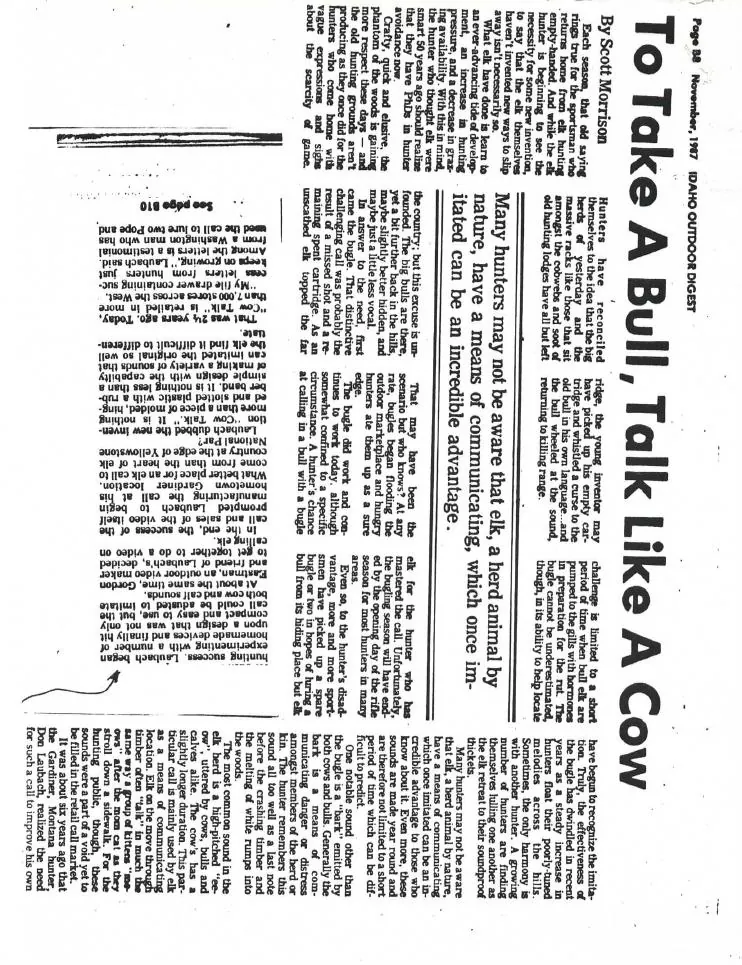 Expand article scan
The piece captures the product, technique, and education system reaching hunters beyond Montana by 1987.
Metadata retained from the preserved archive index; consult the source scan. Details marked for verification remain unresolved.
Open Complete Source PDFHistorical materials may include period prices and addresses. For current inquiries, use our Contact page.